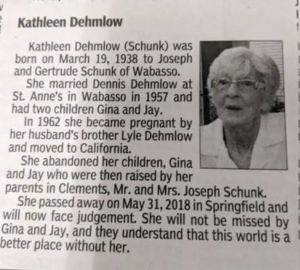
The obituary for Kathleen Dehmlow, published by *The Redwood Falls Gazette*, quickly drew public attention and outrage due to its surprising content. While it started as a typical tribute, the obituary soon revealed deep-seated family animosities. Kathleen’s two adult children used the platform to express personal grievances, culminating in a final sentence that shocked readers.
The obituary was eventually removed from the newspaper’s website after widespread backlash, but by that time, it had already gone viral. A family member, Dwight, confirmed the obituary’s contents and explained that Kathleen had made “a significant mistake six decades ago” but had shown remorse. He criticized the obituary’s author for publicly airing family issues, arguing that it would “inflict considerable suffering on numerous people.”
Despite the controversy, the newspaper defended its decision to publish the obituary, stating there was “no legal prohibition” against its content. The CEO mentioned that their newspaper partners “uphold high content standards” and took the complaints seriously, promising a thorough review of the obituary.
This incident highlights how obituaries, traditionally intended as respectful tributes, can sometimes become platforms for unresolved family conflicts and candid revelations, with the potential to cause significant public and private repercussions.
The obituary for Kathleen Dehmlow began as a heartfelt tribute, detailing her life and accomplishments. However, it took an unexpected turn when her children used the platform to air their grievances. They accused Kathleen of abandoning them and leaving them to be raised by their grandparents. The tone shifted from one of mourning to one of anger and resentment, with the obituary painting Kathleen in a negative light.
The final sentence of the obituary was particularly shocking, stating that she would not be missed by her children, Gina and Jay. This harsh statement sparked outrage among readers, who felt that an obituary was not the appropriate place to settle family scores. Many criticized Gina and Jay for their lack of compassion and empathy, questioning their decision to publicly shame their mother in death.
The obituary quickly went viral, drawing attention from news outlets and social media users. People were divided on the issue, with some condemning Gina and Jay for their actions and others sympathizing with their pain and anger. The newspaper ultimately decided to remove the obituary from their website, but the damage had already been done.
This incident serves as a cautionary tale about the power of words and the impact they can have on relationships, both in life and in death. While it is natural for families to have disagreements and conflicts, using an obituary as a platform to express anger and resentment is not only hurtful but also disrespectful. It is a reminder to think carefully about the words we choose and the emotions we express, especially in moments of grief and loss.